Let’s get the price question out of the way first: yes, a custom handcrafted piece from a Charles County woodworker costs more upfront than something from a big-box store. That’s true, and we’re not going to pretend otherwise. What we are going to do is explain exactly what that difference buys you — because when you understand what goes into a piece built by hand versus one assembled from particleboard and screws, the value calculation changes completely.
Understanding the differences between handcrafted vs flat pack furniture is crucial when making a decision on your next furniture purchase.
At Over The Tabletop, we’ve talked to enough Southern Maryland homeowners to know the pattern. They buy flat-pack, live with it for three or four years, watch it swell or sag or lose a joint, and then they call us. We’d rather they called us first — so here’s the honest comparison.
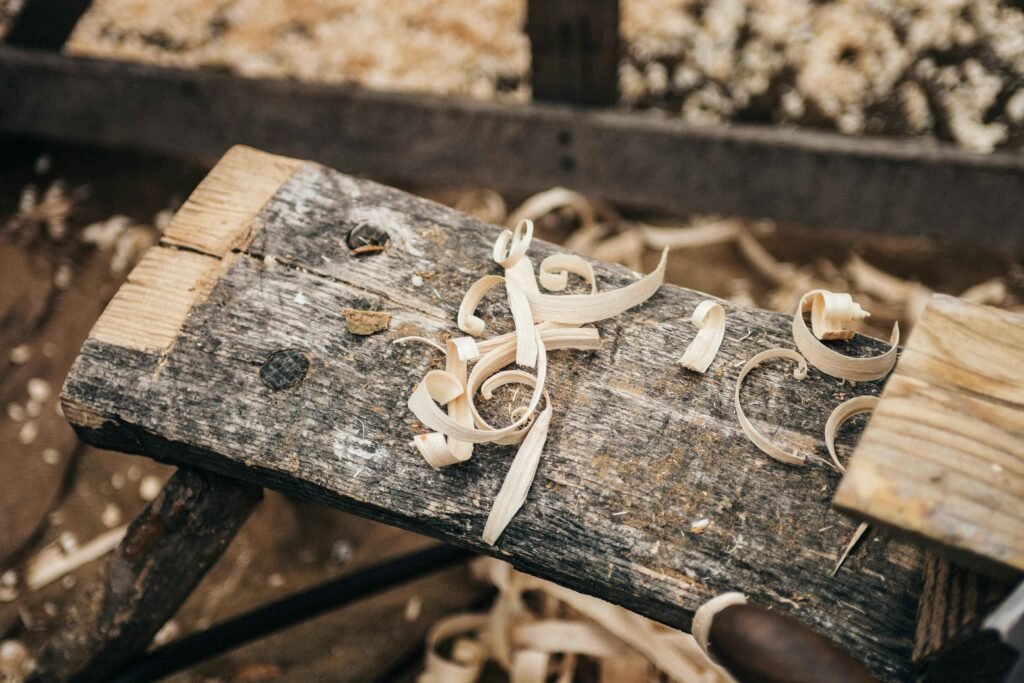
What Flat-Pack Is Actually Made Of
Most furniture sold at major retailers — and almost all of it in the entry-to-mid price range — is made from medium-density fiberboard (MDF) or particleboard. These are engineered wood products: wood fiber or chips compressed with adhesives under heat. They’re inexpensive to produce, easy to machine, and consistent. They’re also hygroscopic in the worst way — they absorb moisture and swell, but they don’t return to their original dimensions when they dry out. After enough humidity cycles, the structure fails.
The furniture isn’t designed to last 20 years. It’s designed to survive its warranty period.
The Real Differences, Side by Side
| Factor | Flat-Pack / Mass-Produced | Handcrafted Solid Wood |
|---|---|---|
| Core material | MDF, particleboard, veneer | Solid Cherry, Oak, Maple, Cedar, Walnut |
| Joinery | Cam locks, dowels, glue | Mortise & tenon, dovetail, hand-fitted |
| Humidity resistance | Swells and fails over time | Expands and contracts without structural failure |
| Repairability | Nearly impossible to repair | Joinery can be re-glued, surfaces refinished |
| Aesthetic over time | Degrades — chips, peels, sags | Improves — patina deepens, character grows |
| Resale / heirloom value | Near zero after use | Holds value; often passed to next generation |
| Fit to your space | Standard sizes only | Built to your exact dimensions |
The Maryland Humidity Factor
We’ve written separately about how wood species handle Maryland’s climate, but it’s worth highlighting here: the wood in a flat-pack piece and the wood in a solid custom piece respond to Southern Maryland’s summers in completely different ways. MDF and particleboard absorb and hold moisture. Solid wood moves with the seasons in a predictable, manageable way — which is why a piece of cherry furniture can outlive everyone in the house.
“A well-made solid wood piece doesn’t just survive Maryland summers — it develops character through them. Flat-pack survives one or two before the joints start to go.”
What You’re Really Paying For
When you commission a piece from a Charles County woodworker, the price includes things that simply don’t exist in a factory-made product. You’re paying for the selection of each board at the lumber yard — checking for grain direction, figuring out how the wood will move. You’re paying for joinery that’s been fitted by hand and won’t loosen in three years. You’re paying for a finish that’s been applied in multiple coats, sanded between each one, and chosen specifically for how that piece will be used and where it’ll live.
And you’re paying for a piece built to your actual dimensions. Not “close enough.” Not “the 68-inch version that’s slightly too wide but I’ll make it work.” Exactly what you need, in the wood you choose, finished the way you want it.
The Long Math for Handcrafted vs Flat Pack Furniture
Run the numbers over a decade and the story shifts. A $400 flat-pack bookshelf replaced every five years costs $800 over ten years — and you’ve dealt with two sets of assembly instructions and two disposal trips. A $900 solid oak bookshelf built in our Charles County shop is still standing in twenty years, potentially refinished once, and worth something as a piece of furniture when it’s eventually sold or passed on.
That’s not an argument for everyone — budgets are real, and there are contexts where flat-pack makes total sense. But if you’re furnishing a room you care about, building something for a child’s bedroom, or looking for a piece that will still be in the family two generations from now, the math on custom woodworking looks very different.
Over The Tabletop is built around one principle: things worth making are worth making right. If you have a project in mind, we’d love to talk about it.
Start With a Conversation
Free quotes, 24-hour response time. No templates, no catalog — just your idea, built by hand in Charles County, MD.